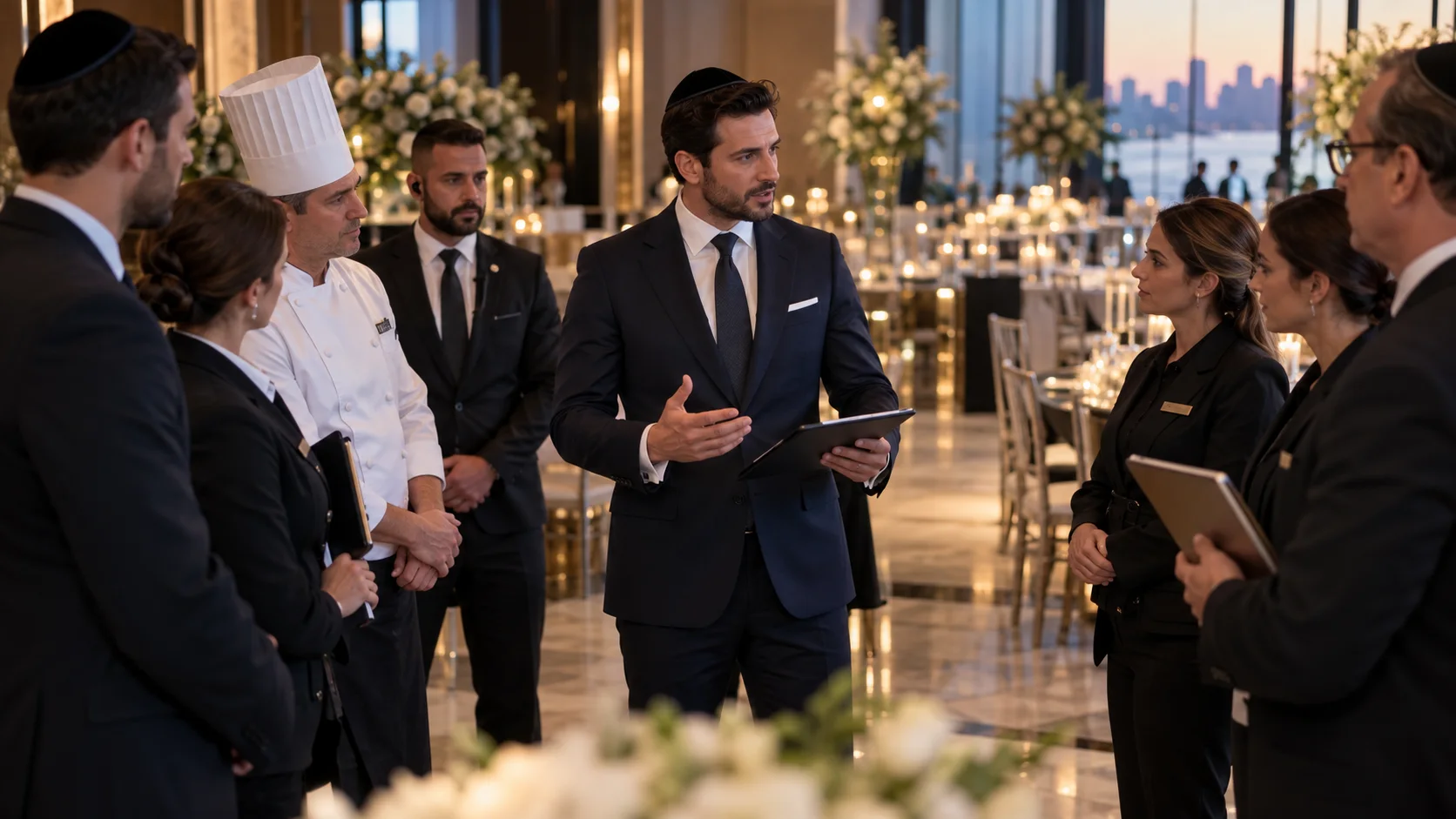
Bring a Shalem Captain into the event.
For high-complexity Jewish events, Shalem owns the cross-functional operating view: readiness, handoffs, runbooks, staff briefings, exceptions and escalation.
Explore Jewish Hospitality Operations →Your planner plans it. Your caterer feeds it. Your mashgiach protects kashrut. Your venue runs the property. Shalem connects the Jewish operational layer between them — before the gaps become the family's problem.
If you have ever watched an excellent hotel, venue or event team discover the same Shabbat requirements in real time — this is the service you wished already existed.
There are excellent specialists in each of those disciplines. Shalem is the operating layer between them: we operate the most complex Jewish events through our own Captains, then turn what works into role-specific training and certification for the hospitality professionals already inside hotels, venues, cruise programs, catering teams and event companies.
For high-complexity Jewish events, Shalem owns the cross-functional operating view: readiness, handoffs, runbooks, staff briefings, exceptions and escalation.
Explore Jewish Hospitality Operations →Hotels, cruises, planners, caterers and venues train and certify existing personnel by role — creating reusable capability instead of rebuilding knowledge for every Jewish event.
Explore Shalem Certification →That is the problem Shalem is designed to remove.
Shalem means whole. Complex Jewish hospitality already has specialists in every lane. The problem appears in the spaces between them.
We do not replace those experts. We make the experience operate as one complete system — with one operating view, one responsibility map, one escalation structure and one person accountable for the Jewish hospitality layer.
Most failures are not caused by incompetence. They happen because excellent people are working inside separate lanes — while Jewish requirements cross all of them at once.
What must be complete before the operating environment changes? Who owns each dependency? What is unresolved?
Which issue belongs to the planner, venue, caterer, mashgiach, security or family — and how does the handoff occur?
Do front desk, banquet, housekeeping, engineering, security and guest services understand what their roles require?
Who recognizes the exception, routes it correctly and prevents a small operational issue from becoming the family's problem?

A Shalem Jewish Hospitality Captain is the operational lead responsible for making the Jewish requirements of a complex event work across the people already delivering it.
Shalem is intentionally collaborative. The strongest planners, caterers, mashgichim, venues and security teams should feel more effective with us in the room — not threatened by us.
Pricing is based on operational responsibility and complexity — not simply on hours. The figures below are founding-range starting points and are confirmed after event and venue review.
For an event that needs a dedicated Jewish Hospitality Operations lead.
For weddings, Bar/Bat Mitzvahs, retreats and programs spanning Friday through Shabbat.
For destination events requiring coordination across hotel, planner, caterer, guest logistics, security and Jewish requirements.
For significant Jewish programs where Shalem assumes responsibility for the complete Jewish hospitality operating layer.
Shalem belongs where multiple teams, Jewish requirements, hospitality operations and guest expectations must work together — especially across Shabbat, Yom Tov and multi-day programs.

The Standard is the reusable knowledge beneath both businesses. Our Captains apply it live. Third-party hospitality professionals learn the parts relevant to their roles. Every serious engagement gives the Standard more field evidence.
Shalem does not need to employ every planner, banquet manager, server, concierge, hotel manager or cruise-team member. The scalable model is to train and certify the professionals who are already there.
The Shalem Standard turns role-specific Jewish-hospitality fluency into a verifiable professional credential. For the individual, it is a differentiated skill. For the employer, it is visible capability they can point to when pursuing Jewish weddings, Shabbat weekends, kosher travel programs and other high-value business.
Add a verifiable specialty to an existing hospitality career without becoming a religious authority.
Build credentialed capability across the roles that repeatedly touch Jewish guests and events.
Know which personnel have actually completed role-specific training and assessment.
Professionals complete role-specific Shalem Academy modules and controlled assessments, then receive a time-limited credential that verifies what they have actually been trained to understand and execute.
Hotels, cruise programs, caterers, event companies and venues can certify the personnel they already employ — creating repeatable Jewish-hospitality capability without rebuilding a team for every event.
The exact tracks will be developed from real operating needs, but the model is intentionally role-based rather than generic. A front-desk manager, banquet captain and event planner should not receive the same curriculum.
A luxury property should not have to relearn the same Jewish-event requirements every time a new wedding, Shabbat weekend or holiday program arrives.
Shalem trains and certifies the personnel already responsible for the guest experience — role by role — so the organization can retain operational knowledge, reduce repeated explanation and present a more credible team when competing for Jewish weddings, Bar/Bat Mitzvah weekends, Shabbat programs, retreats, conferences and destination events.


Food is only one part of the operation. Guest services, housekeeping, events, security, cabin access, meal transitions, scheduling and Shabbat flow all intersect — often across a rotating crew.
Shalem can train and certify the people already on board by role, while a Shalem Captain can sit over the Jewish hospitality layer for programs whose complexity warrants live operational leadership.
The Academy teaches third-party hospitality professionals only the Jewish operational knowledge their existing roles require. A front-desk manager, banquet captain, planner and cruise guest-services lead should not take the same course. Shalem Captain training is a separate, deeper internal discipline for our own operators — not the public credential.

Most Jewish-event know-how disappears when the weekend ends — inside somebody’s inbox, memory or WhatsApp thread. Shalem structures what was learned so future runbooks, training and venue preparation become more precise.

Every founding engagement does two things: it solves the event in front of us, and it contributes field evidence to the Standard that can later train thousands of professionals. We are deliberately choosing complex events and serious hospitality partners where the operating gap is real.
Tell us whether you are planning a complex Jewish event, operating a hospitality program, or want to certify the personnel you already employ. We will tell you which Shalem path actually fits — and which one does not.